
 Below you’ll find a few concise excerpts from my book The Smart Girl’s Guide to the G-Spot to get you started. Also, be sure to check out the book’s fun, fierce introduction. At the bottom of this page, check out the additional resource links for anatomy illustrations and more. Read about the controversial G-Spot enhancement injection procedure here.
Plainly put, the g-spot is an area just inside your vagina, that when you’re turned on, might feel really good to rub or massage. It might even feel so good you have an orgasm from that type of stimulation alone. About 1-2 inches inside and on the front (bellybutton side) of your vaginal canal is where urine leaves your body — your urethra. The urethra is a little channel between your bladder and the outside world, and it’s surrounded with erectile tissue (like in a penis) and about 40 glands and ducts that all respond pleasurably to stimulation. Sometimes it’s the urethra, or the area right around it, that feels the best to stimulate. That’s it — and in the book I’ll explain exactly what everything is, precisely how to locate it, how to touch the area and what it should feel like and much more.
Excerpt, chapter 2: The Smart Girl’s Guide to the G-Spot:
(…) The area of the clitoris is far larger than described in conventional anatomy texts and most sex guides. The external tip, or glans, is really the tip of the iceberg — and if you know icebergs, they’re like upside-down pyramids and this is a perfect analogy. The glans begins at the tip of the shaft and continues under the surface to where the other end connects to the suspensory ligament at the pubic mound. You can feel this connection between your clit and the pubic bone by rolling your finger across the area; it feels somewhat like a soda straw (and feels firmer when you’re aroused). The shaft, like the glans, is very sensitive and responds pleasurably to stimulation. At the shaft’s connection to your pubic bone, the clitoris runs underneath both sides of your vulva alongside the vaginal opening in a wishbone shape, forming two legs, or crura, and extends all the way to your perineum.
The internal area occupied by the clitoris and crura is actually a complex clitoral system, wrapped in erectile tissue — just like the stuff that fills with blood during arousal to make a penis hard. The connecting nerves, tissues, muscles, and ligaments all react and engage with one another during your arousal cycle. And guess what? Your g-spot has the princess seat right in the middle of all this. The clitoral area underneath the inner and outer lips, the ring around the urethra (where urine leaves the body; g-spot), and the wall of the perineum all contain erectile tissues that fill with blood and swell upon arousal — sometimes noticeably, sometimes not. Several layers of muscles line the pelvic floor, connecting the clitoris to these erectile tissues. An oval-shaped muscle of erectile tissue surrounds the inner lips and clitoris, where the vagina and g-spot pass through it, and connects to another oval that surrounds the anal sphincter muscle, encircling the anus.
(…) Both women and men have an identical ring of spongy erectile tissue surrounding the urethra (where urine leaves the body). It is an essential part of the clitoral system and your entire orgasmic network, and even when you simply jack off through clitoral stimulation, your g-spot participates in the orgasm (but more on that in the next chapter). Located inside the vagina, the urethra is a tube that’s roughly two inches long, running from the bladder to the urethral opening on your vaginal wall. This ring of urethral tissue is the outer area that shows you where your g-spot is.
The urethral sponge is located on the front wall of the vagina, toward the belly button; if you’re lying on your back, it’s the “top” of the vaginal wall. From the vaginal opening, it’s roughly one or two inches inside. The outer area is the marker to let you know where the g-spot actually begins, because there’s a lot more of it beneath the surface. In addition to the two inch long urethral canal leading to the bladder, there is a whole lot more surrounding the urethral opening (and sponge) that makes up the entirety of the g-spot, and it all responds to g-spot stimulation; to enjoy your spot and come, you’ll be touching not just the urethral opening but the area surrounding it as well.
The spongy tissues that surround your urethra and comprise your g-spot are a complex bundle of — joy! Along with the erectile tissue, you’ve also got the nerve-rich urethra itself and about 40 super-tiny glands and ducts (called paraurethral glands, or Skene’s Glands) that respond to arousal and pleasure. Sometimes, and in some women, stimulation of the g-spot to orgasm can result in an expulsion of fluid form the urethral sponge — this is female ejaculation (detailed in chapter 5, “Wet Spots: Ejaculation”), and the paraurethral glands and ducts have the starring role in that particular wet, wonderful show. The purpose of the urethra is certainly to have a river run through it, but everything else prefers to play by the same rules as your clitoris: just for fun, thanks.
How to Get There From Here
Want to feel it? One way is to stop a stream of urine, mid-flow. Doing this, you’re flexing your PC muscles (the sling of pelvic muscles that engage during orgasm) and putting acute pressure on your g-spot to flex. Another way to investigate the g-spot is with your fingers — putting a finger or two just inside your vagina and stroking the front wall. You’ll have to curl your hand around a bit to get your fingertip to stroke the front wall, so sitting down on a stool or hard chair might make it easier for you to spread your legs, push your pelvis forward, and feel. I highly recommend using a water- or silicone-based lubricant in your explorations, as slick surfaces are easier to detect under your fingertips. I recommend a variety of excellent lubricants for g-spot exploration in chapter 3, “Turn It On, Turn It Up”.
What you’re feeling for is a soft bump or slight change in the surface of your vaginal wall. If you touch yourself just inside your vagina, you’ll notice that the surface near the opening is slightly furrowed with subtle ridges, and a bit more so in the area where you’ll be concentrating your search for the urethral opening. It’s interesting to note that this ridgy outer area of the vaginal canal (about the inner 1/3) is most sensitive to touch, vibration and more subtle textures and shapes than the smooth-walled inner part, which cares less about vibration and responds pleasurably to sensations like fullness, rhythm and thrusting (the inner 2/3). If you’re feeling like exploring, touch and press all around your urethral opening while squeezing your vaginal muscles and see if you can feel what’s beneath the surface.
If you’re unaroused, the urethral sponge is relaxed and might be difficult to feel. But during arousal, your sponge swells and hardens, and it becomes more obvious to touch. Touching it in an unaroused state might feel strange, like you have to pee a bit, or it might be too sensitive to touch — or it might feel good. It might even feel really good. You may find that touching it turns you on a little, and that once your g-spot is firm with arousal, massage and vibration are delightful. Just try a simple touch once, and see what you think.
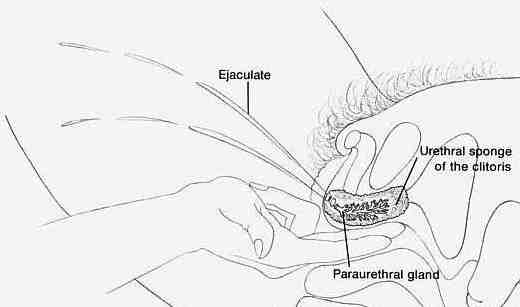
Image from the book (out of print) A New View of a Woman’s Body, illustrated By: Suzann Gage, L Ac, RNC, NP
Listen to my G-Spot lecture (which I give to sex ed classes), where I explain all about the G-Spot, how to find it, what it likes, tips for couples, and even female ejaculation. You can download it here in my podcast Open Source Sex or you can click here to listen to my G-spot talk right now in this pop-up audio player.
What is “squirting” or female ejaculation?
Of course one of the most controversial, most contested sexual responses is female — specifically, the act of female ejaculation. Ludicrous, luscious, lascivious… and also denied, debated, sometimes even dreaded. This physical response, part of orgasmic function, has a lot of mystery and so much to offer. This week, a Wife wants to know, what’s up with the squirting?
Question: I am curious about “squirting.” I have a new boyfriend and it is happening and OMG, it feels beyond good. Would love to hear more about it the how and whys? (It does not happen with each partner.)
Violet: That’s great news, and especially that you enjoy it — you’re really having fun now! Not all women “squirt” (aka ejaculate) and not all women care to. It’s a matter of your inclination to do so, your body’s inclination to do so (some women can train themselves to squirt but not all are successful at it), and whether or not you like the sensation.
Some women do like it a lot, not just because it brings intensity to orgasm but because it’s an orgasm they can share with their lover, right before their eyes. It’s quite common to discover that you ejaculate by accident, when you have a really intense orgasm and unintentionally soak the bed and your surprised lover.
An orgasm with ejaculation is telling you that your G-spot has come alive; a G-spot orgasm is what you’re experiencing, a really intense one. So wonderfully intense that the glands which help comprise the G-spot (Skene’s Glands) are caught up in the contractions of orgasm and push out fluid; this fluid is analogous to the same fluid in men that comes from the prostate to create seminal fluid. Similar, but not the same thing.
Some women will expel a lot of fluid (up to one and a half cups!) — many women who “gush” may have thought the first time they ejaculated that they were urinating. The fluid has been analyzed in recent years by MD’s and it is most definitely not urine. Many women ejaculate a smaller amount, around a teaspoon.
Learning about how to ejaculate might answer your questions as to why you’re ejaculating with one partner more frequently, but have not reliably ejaculated with others. Conjuring ejaculation is similar to seeking out a G-spot orgasm, with a twist. To pleasurably play with your ‘spot, begin by arousing yourself in your usual ways (such as clitoral stimulation). When you’re excited, begin to stroke the G-spot area — this is around the urethral opening, where urine leaves the body. It’s about 1-2 inches inside your vagina, and on the front wall (toward your bellybutton).
The G-spot (see also: The G-Spot Resource Center) likes to be massaged by firm, smooth and sometimes heavy objects: that’s why specific G-spot toys such as hard plastic, glass, even metal or stone are recommended. Once you’re turned on, the G-spot will love being rubbed with a hard toy using a significant amount of pressure; really pressing toward the front of the body. Many G-spot toys are curved to make this easier. Add a vibrating G-spot toy, and you might see the stars!
When you’re about to have a G-spot orgasm, it might feel like you have to pee a little bit; some women back off at this point. Others “push through” this sensation, and these are women who ejaculate. Happily.
It’s possible that your new playmate is hitting your spot just right, and you’re pushing through (bearing down) into your orgasms. He might be using his fingers in a “come here” motion during digital stimulation, using a toy on you that’s “just right”, his penis may have a perfect curve for your G-spot, or you could be being penetrated at the perfect angle (woman on top or from behind) to hit your G-spot during orgasm. Lucky him, but… lucky you!
Additional Links
A terrific resource for all things g-spot and female ejaculation is at The Clitoris (the-clitoris.com). Please do read what I think is the ultimate Kegel exercise resource guide by The Mayo Clinic (mayoclinic.com).
Audiobook: There is an audio chapter packed with information about the G-Spot in my audio book open source sex :: pleasure zone basics ($5).
See also: Wikipedia: G-Spot entry (controversial) * respected educator Cory Silverberg on the g-spot * The G-Spot Center